





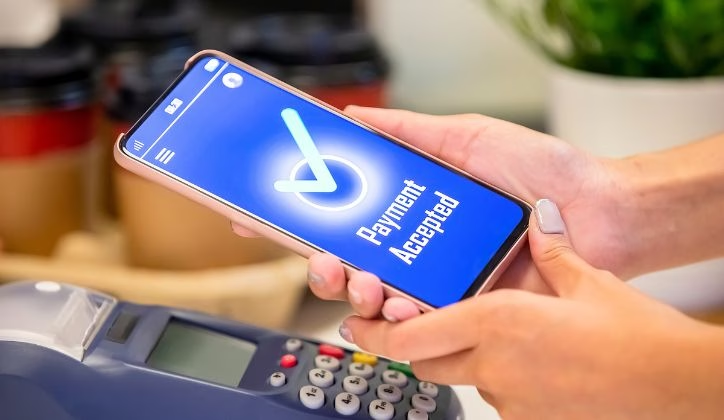
There was a time when paying for something came with a rhythm. Notes unfolded, coins clinked, and a brief pause marked the moment money changed hands. That pause has almost vanished.
Today, a payment can happen in silence. A phone lights up, a watch vibrates, or a QR code flashes, and it’s done. No counting. No waiting. Often, no second thought.
What’s striking isn’t just how fast digital payments spread, but how easily people accepted them. Cash didn’t disappear because it failed. It simply became less convenient than the alternatives quietly lining up to replace it.
From Physical Money to Invisible Transactions
The move toward cashless payments didn’t arrive as a dramatic revolution. It slipped in through small upgrades that felt harmless at the time.
Debit cards reduced dependence on ATMs. Online banking saved trips to branches. Mobile apps removed even the need to carry plastic. Each step shaved off friction, until money stopped feeling like an object and started behaving like data.
At some point, people stopped thinking about where their money was. They only cared that it moved quickly and reliably. That psychological shift, more than any single innovation, set the stage for cashless economies.
Why Digital Payments Took Hold So Quickly
Several forces pushed digital payments from optional to unavoidable.
Convenience Won the Argument
Speed matters. In crowded cities and busy lives, shaving seconds off a transaction adds up. Tap-and-go payments simply fit modern routines better than cash ever could.
Smartphones Changed Habits
Once phones became the center of communication, shopping, navigation, and entertainment, payments naturally followed. Adding one more app didn’t feel like a leap—it felt logical.
A Global Health Crisis Accelerated Trust
The pandemic reshaped behavior almost overnight. Contactless payments moved from novelty to preference. Many first-time users discovered they didn’t miss cash at all.
Policy Support Sealed the Deal
Governments looking to improve transparency, reduce informal cash flows, and expand financial inclusion actively supported digital payment infrastructure. Incentives, regulations, and public campaigns helped normalize the shift.
The Technology Making Cashless Economies Possible
Behind every quick tap is a surprisingly complex system designed to make payments feel effortless.
Mobile Wallets
Services like PayPal, Apple Pay, and Google Pay allow users to store cards, link bank accounts, and authenticate payments securely. The technology stays hidden; the experience stays simple.
Contactless Cards and NFC
Global networks such as Visa and Mastercard upgraded terminals worldwide, making tap-based payments faster than chip-and-PIN ever were.
QR Code Payments
QR codes lowered the entry barrier for small merchants. No machines, no maintenance—just a printed code and a smartphone. This simplicity turned even informal sellers into digital participants.
Real-Time Payment Rails
National systems now enable instant transfers between bank accounts. India’s Unified Payments Interface is often cited as a benchmark, handling billions of transactions every month with minimal cost to users.
India’s Cashless Moment: A Practical Case Study

India offers one of the clearest examples of how quickly a country can adapt when digital payments are built for scale and simplicity.
UPI turned smartphones into payment terminals. Tea stalls, auto drivers, and neighbourhood shops adopted QR codes almost overnight. Consumers followed because transfers were instant, free, and easy to understand.
According to public data and industry estimates, UPI processes tens of billions of transactions annually, moving trillions of rupees across the economy. More importantly, it brought millions into formal finance without forcing them into complicated banking products.
The lesson is straightforward: when digital payments are frictionless and trusted, adoption doesn’t need persuasion.
How Cashless Payments Changed Consumer Behaviour
Digital payments didn’t just speed things up. They subtly reshaped how people think about spending.
Cash creates a moment of awareness. Digital payments smooth that moment away. The result isn’t reckless spending, but easier spending.
You see it in small decisions:
-
Adding one more item to an online cart
-
Choosing convenience over price comparison
-
Paying instantly instead of postponing a purchase
Retailers and banks have tracked this pattern for years, according to consumer behavior studies. When money feels invisible, trust becomes the most valuable currency of all.
What Businesses Learned Along the Way
For businesses, digital payments stopped being a differentiator a long time ago.
Customers don’t notice when payments work smoothly. They notice immediately when they don’t. A failed transaction at a checkout counter can undo months of goodwill in seconds.
Businesses that adapted early discovered unexpected benefits:
-
Cleaner accounting and fewer reconciliation errors
-
Better insight into customer preferences
-
Easier access to credit based on transaction history
Ironically, the best payment systems are the ones customers barely remember using.
Cashless Travel, Hospitality, and Everyday Life
Few sectors embraced cashless systems as quickly as travel.
Airports encourage digital boarding passes and in-app purchases. Hotels offer contactless check-ins and digital room keys. Public transport in many cities now works entirely through cards or mobile apps.
For travelers, the appeal is practical:
-
No currency exchange stress
-
Clear spending records
-
Faster refunds and dispute resolution
Cashless payments removed friction from experiences where time and convenience matter most.
Is Digital Money Really Safer Than Cash?
Security remains the most common concern—and not without reason.
Digital payments reduce risks tied to theft and counterfeit currency, but introduce new challenges around data protection and cybercrime. Modern systems rely on tokenization, encryption, biometric authentication, and real-time fraud monitoring.
Industry data suggests that fraud losses as a percentage of total transaction value are often lower for digital payments than losses linked to cash handling. Still, trust depends on transparency and strong consumer protections.
Cashless economies work best when users feel protected, not monitored.
Financial Inclusion: Progress With Caveats
Digital payments have brought millions into formal financial systems, especially in emerging markets. Mobile-based platforms bypassed traditional banking barriers like paperwork and physical branches.
Yet challenges remain:
-
Older users may struggle with app-based interfaces
-
Rural connectivity gaps still exist
-
Privacy concerns continue to grow
Successful cashless models address these gaps with education, simple design, offline functionality, and clear data protection laws.
The Government’s Balancing Act
Governments play a quiet but critical role. They must encourage innovation while protecting citizens from abuse.
Key priorities include:
-
Interoperability between payment platforms
-
Consumer grievance redressal systems
-
Cybersecurity standards and audits
When regulation feels fair and predictable, trust follows. When it doesn’t, adoption slows.
What Cashless Economies Mean for the Future of Money
Cash isn’t disappearing tomorrow. In many cultures, it still holds emotional and practical value. What’s changing is its role.
Digital payments are becoming the default. Money is turning into information—tracked, analyzed, and optimized in real time. This opens doors to smarter financial products, but also demands restraint and responsibility.
The real question is no longer whether societies will go cashless, but how thoughtfully they manage the transition.
Practical Takeaways
For consumers:
-
Enable multi-factor authentication on payment apps
-
Monitor transaction alerts regularly
-
Carry a backup payment option while traveling
For businesses:
-
Offer multiple digital payment choices
-
Train staff to handle cashless systems confidently
-
Use payment data to understand customer behavior, not just revenue
Conclusion
The rise of digital payments wasn’t driven by hype or grand promises. It succeeded because it respected people’s time and quietly removed steps no one was emotionally attached to.
Cash didn’t lose relevance overnight. It simply stepped aside as money learned how to move faster, quieter, and with less resistance.
Once people experience that ease, the expectation sticks. And expectations, more than technology, are what truly shape cashless economies.