

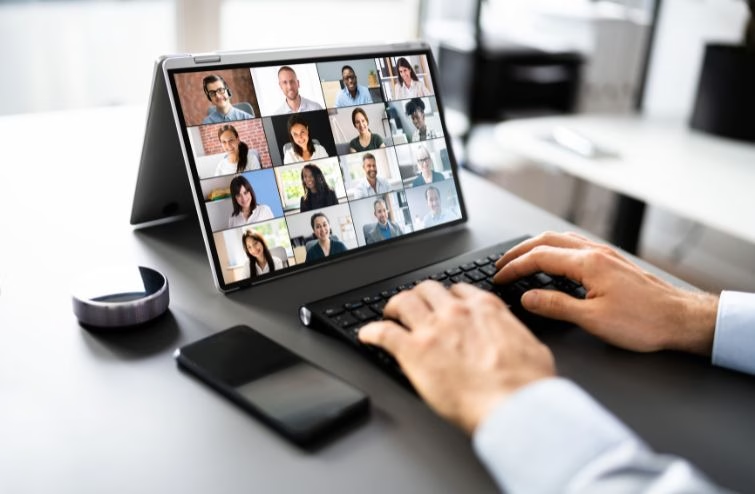
When offices shut and laptops came home, many professionals thought they had finally cracked the work-life balance puzzle. No commute. No rigid schedules. Meetings in comfortable clothes. On paper, it sounded like progress.
But something unexpected happened along the way. Work didn’t shrink to fit life. It quietly expanded into it.
Days blurred. Evenings felt half-owned by email. Weekends carried a low hum of unread messages. People weren’t necessarily working longer hours—but they were thinking about work far more often.
Remote and hybrid work didn’t destroy work-life balance. It exposed how fragile it always was. What changed wasn’t just where we worked, but how deeply work entered our personal space. And once that door opened, closing it again proved harder than anyone anticipated.
Before Remote Work: Balance Had Built-In Boundaries
Work-life balance used to rely on physical separation. You left the house, went somewhere else to work, then returned. The commute—annoying as it was—created a psychological handover between roles.
Even demanding jobs followed predictable patterns:
-
Work had a location
-
Availability had rough limits
-
Personal time felt more defensible
The system wasn’t humane, but it was structured. You could resent your hours and still know when the day ended.
Balance back then was mostly about endurance and scheduling. You planned around work. You didn’t negotiate with it constantly.
That changed the moment work moved inside the home.
Remote Work Didn’t Kill Balance—It Removed Defaults
Remote and hybrid work didn’t make balance impossible. They removed the automatic guardrails.
Suddenly, employees had to decide—every single day—when work starts and stops. And decision fatigue is real.
According to workplace studies shared by Microsoft and Gallup, digital activity outside standard working hours rose sharply once remote work became widespread. Not because people were forced to work longer, but because nothing clearly told them not to.
Without physical cues, work became ambient. Always nearby. Always accessible.
And accessibility quietly turned into expectation.
The Upside Few People Talk About Honestly
Despite the challenges, remote and hybrid work genuinely improved life for many professionals. But not in the glossy way it’s often marketed.
Time That Finally Belongs to People
Removing daily commutes returned hours to people’s lives. For some, that meant better mornings. For others, it meant being present for children, elderly parents, or personal health.
This mattered most for:
-
Working parents
-
Caregivers
-
Employees managing chronic conditions
Flexibility wasn’t about comfort—it was about dignity.
Control Over Energy, Not Just Schedules
Remote work allowed people to organize tasks around mental energy rather than clock time. Deep thinking in the morning. Lighter tasks later. Breaks that actually refreshed instead of just paused exhaustion.
When autonomy was real—not performative—people didn’t just work differently. They worked better.
Where Things Quietly Went Wrong
The problem wasn’t flexibility. It was the absence of limits.
The Pressure to Be Seen While Unseen
In offices, visibility happens naturally. Remote work replaced that with performative responsiveness.
Employees began compensating by:
-
Replying instantly
-
Over-documenting trivial updates
-
Staying online longer than necessary
Not because they were told to—but because silence felt risky.
Home Became a Soft Office
When your workspace shares a wall with your personal life, work stops having an edge. Small intrusions—checking messages during dinner, opening the laptop “just for five minutes”—became habitual.
Over time, recovery suffered. And without recovery, productivity becomes hollow.
Burnout didn’t arrive dramatically. It crept in wearing the mask of commitment.
Hybrid Work: Flexibility With Conditions
Hybrid work was meant to combine freedom with structure. In practice, outcomes vary wildly.
When Hybrid Models Succeed
Hybrid setups work best when they’re designed intentionally, not politically.
Successful organizations tend to:
-
Define why in-office days exist
-
Avoid penalizing remote visibility
-
Ensure decisions aren’t made in hallway conversations
Office time becomes purposeful—not symbolic.
When Hybrid Models Fail
Problems arise when hybrid becomes a performance exercise. Employees feel pressured to “show up” physically while still maintaining remote-level responsiveness.
The result? Two work modes layered on top of each other.
That’s not balance. That’s duplication.
Leadership Behavior Matters More Than Any Policy
Work-life balance lives or dies at the managerial level.
Employees rarely follow written guidelines. They follow behavior.
If leaders send late-night messages, people internalize that as expectation—even when disclaimers say otherwise. If managers never disconnect, teams hesitate to do so themselves.
Healthy cultures share a few traits:
-
Leaders respect response delays
-
Output matters more than availability
-
Time off is visibly used, not just approved
Trust replaces surveillance. And when trust increases, anxiety drops.
Technology Isn’t the Villain—Unexamined Use Is
Remote work depends on technology. The issue isn’t the tools. It’s how thoughtlessly they’re used.
Helpful Technology Habits
-
Asynchronous communication by default
-
Fewer meetings with clearer agendas
-
Documentation replacing repetitive updates
These reduce interruption without reducing accountability.
Harmful Patterns
-
Notifications with no priority logic
-
Meetings scheduled out of convenience, not necessity
-
Tools overlapping without purpose
Many professionals now spend more time managing work than actually doing it.
That’s not efficiency. That’s friction disguised as collaboration.
Mental Health and Balance Are Tightly Linked
Remote and hybrid work reshaped stress patterns rather than eliminating them.
Isolation replaced overstimulation for some. Constant connectivity replaced rigid hours for others.
Industry surveys consistently show that employees who feel control over their schedules report:
-
Lower stress levels
-
Better focus
-
Greater job satisfaction
Those who don’t feel that control burn out faster—even in flexible environments.
Balance isn’t a wellness trend. It’s a risk management strategy.
What’s Actually Working: Real Examples
A Distributed Tech Company Rewrites Availability Rules
A global software firm limited synchronous communication to defined windows. Everything else moved async.
The outcome:
-
Meeting volume dropped
-
Employee satisfaction rose
-
Productivity remained stable
People stopped confusing urgency with importance.
A Professional Services Firm Confronts Overwork
After internal reviews revealed longer remote hours than pre-pandemic office norms, leadership intervened.
They introduced:
-
Clear workload caps
-
Mandatory offline time
-
Manager training on capacity planning
Attrition slowed. Trust improved.
What Individuals Can Do Without Burning Bridges
Balance isn’t solely an organizational responsibility—but it shouldn’t be an individual burden either.
That said, a few personal practices help.
-
Make availability visible and consistent
-
Stop apologizing for boundaries
-
Create end-of-day rituals that signal closure
Even symbolic separation matters more than people realize.
What Companies Must Stop Pretending
Work-life balance isn’t about perks. It’s about power dynamics.
Organizations serious about sustainability do a few things well:
-
They measure output, not presence
-
They train managers, not just employees
-
They treat workload as a system issue, not a resilience test
Employees don’t leave because work is hard. They leave when work is endless.
Conclusion: Balance Is Designed, Not Discovered
Remote and hybrid work didn’t solve work-life balance. They forced everyone to confront it.
There’s no universal formula anymore. Balance now depends on clarity, trust, and the courage to define limits—at both personal and organizational levels.
The professionals who thrive in this new reality aren’t those who stay online the longest. They’re the ones who know when to disconnect without guilt—and are supported when they do.
That’s not just healthier work.
It’s smarter work.